The Build–Grow–Scale Framework for Developing and Scaling Ecommerce Stores
At Webgarh Solutions, we deliver end-to-end digital commerce - from custom storefronts to advanced enterprise integrations. Our approach fuses strategic consulting, innovative technology, and ongoing optimization to help you outperform and outscale the competition.
Most ecommerce stores don’t fail because of poor ideas. They fail because technical decisions made too early—or too late—slow down growth. After working across multiple ecommerce builds and scale-ups, one pattern consistently emerges: stores that succeed treat development as a sequence of clearly defined phases rather than a single continuous effort.
The Build–Grow–Scale model provides a practical framework for aligning ecommerce website development with business maturity. Instead of overengineering from day one or scrambling to fix limitations later, this approach helps teams make the right decisions at the right time.
Understanding the Core Problem in Ecommerce Development
Ecommerce teams often approach development as a one-time project. They invest heavily upfront, adding features meant for future growth before validating current needs. In other cases, they move quickly with minimal structure and later struggle when traffic, orders, or integrations increase.
The underlying issue is misalignment between business stage and technical execution. Ecommerce website development should evolve as the business grows, but many platforms are forced to scale architectures that were never designed for expansion. The Build–Grow–Scale framework exists to solve this disconnect.
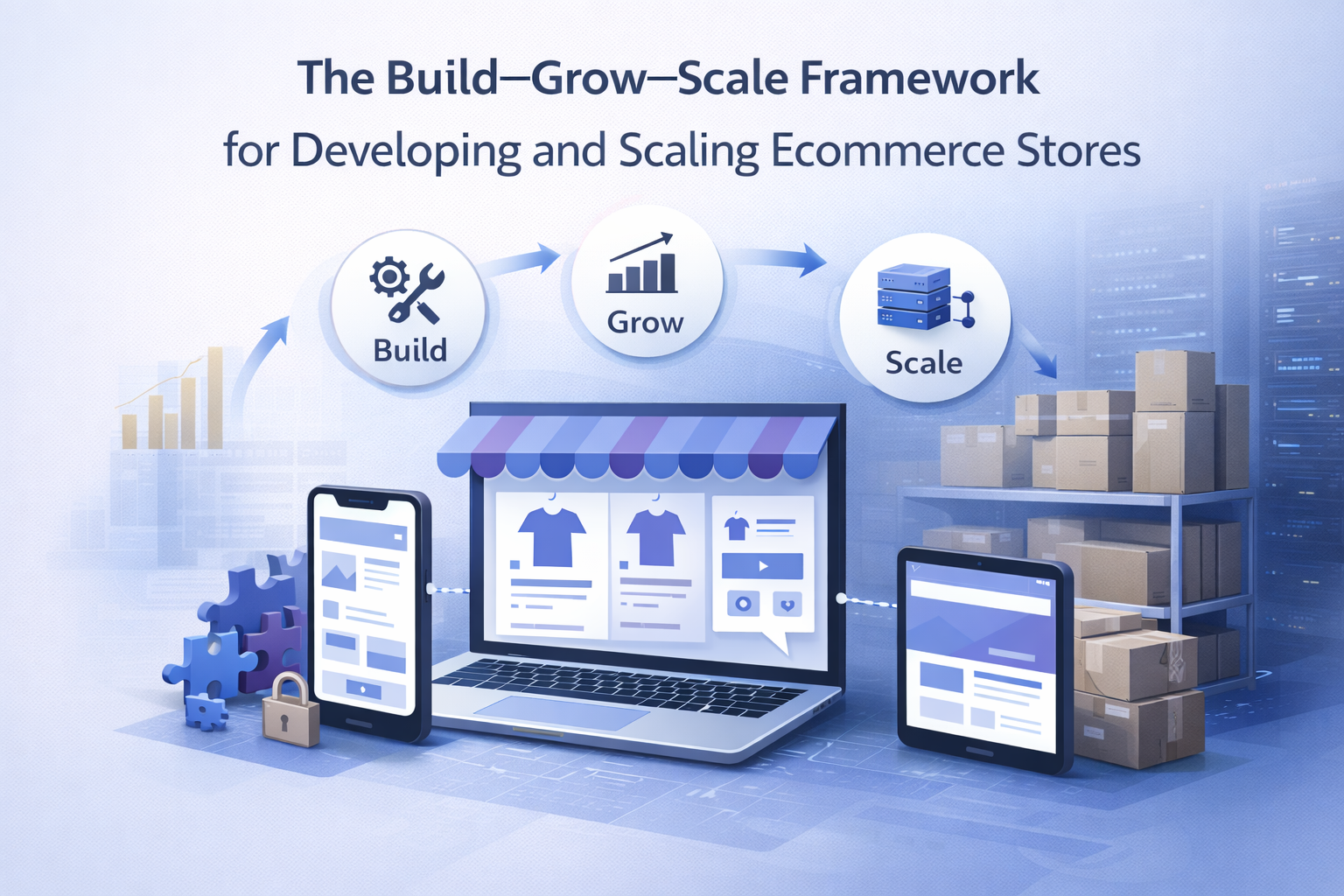
The Build–Grow–Scale Framework Explained
The framework is built around three distinct phases. Each phase has a different objective, technical focus, and success metric. Treating them separately allows teams to move faster without creating long-term constraints.
Build: Creating a Stable Foundation
The build phase is about establishing reliability, not complexity. At this stage, the goal is to launch a functional storefront that supports core commerce operations without unnecessary overhead.
Effective shopify store development during the build phase focuses on clean architecture, essential integrations, and a user experience that prioritizes clarity over customization. Overengineering here often leads to technical debt that becomes expensive during later growth.
In real-world projects, teams that keep the build phase lean are able to iterate faster and gather meaningful customer feedback without being locked into rigid systems.
Grow: Optimizing for Traction and Performance
Once traffic and conversions begin to increase, the focus shifts from stability to optimization. The grow phase is where online store development becomes more data-driven, guided by user behavior, performance metrics, and conversion insights.
During this phase, teams refine page speed, improve checkout flows, and introduce features that directly support customer acquisition and retention. Growth-oriented development requires flexibility, which is why platforms that support modular enhancements perform better at this stage.
From experience, this is also where many stores encounter their first scaling friction, particularly if earlier build decisions limited extensibility.
Scale: Preparing for Long-Term Expansion
Scaling introduces complexity that cannot be solved with incremental fixes. High order volume, internationalization, custom workflows, and system integrations place significant strain on storefront architecture.
At this point, ecommerce store development becomes less about adding features and more about restructuring systems to support sustained growth. Teams often adopt headless architectures, optimize infrastructure, and invest in automation to reduce operational load.
A clear scaling model allows businesses to expand confidently without sacrificing performance or customer experience.
When to Apply the Build–Grow–Scale Model
This framework is most effective when teams recognize that not all growth stages require the same technical solutions. Early-stage businesses benefit from simplicity, while mature operations need flexibility and scalability.
Based on real ecommerce implementations, applying this model early helps prevent rushed migrations, reactive fixes, and costly replatforming efforts. It also improves collaboration between development, marketing, and operations teams by aligning technical priorities with business goals.
Conclusion
Ecommerce success is rarely driven by technology alone. It comes from making disciplined decisions that match development effort with business maturity. The Build–Grow–Scale framework provides a clear path for developing ecommerce stores that can evolve without breaking under pressure.
By treating build, growth, and scale as distinct phases, teams reduce technical debt, improve performance, and create systems that support long-term success rather than short-term wins.
For a deeper explanation of how ecommerce teams apply this build–grow–scale approach in real development scenarios, this reference provides a structured overview.